Lately I have been really into photography and have been
reading books with tips on taking photos. When looking for more books on
photography, I stumbled upon A History of Photography in 50 Cameras.
This book goes through the evolution of 50 different cameras ranging from 1839 –
2013. It has images of photos taken by each camera as well as detailed sketches/blueprint
of the camera. So, to get a feel of the book, here are 3 cameras that I found
interesting.
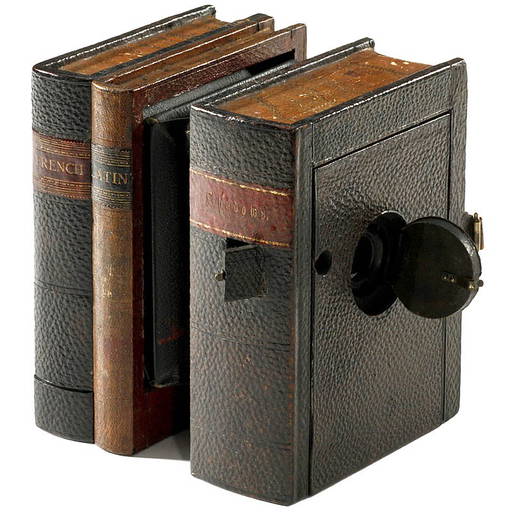
Reading this book, I found it fascinating that these camera
inventors really loved making disguised cameras. A camera disguised as a revolver,
a pocket watch, and a matchbox were all mentioned in this book, but I found the
Scovill Book Camera the most interesting out of these secret cameras. Three
leather covered books with a strap attached to it, was made in 1892 in the
United States, by Scovill and Adams. Andrew D. Dobbs, the inventor of this
camera, was really focused on making the camera into a realistic book, with
titles on each book and the strap needing to be unbuckled for it to function as
a camera. I found it funny that although Dobbs wanted to disguise the camera,
by making it into a book it became obvious when used to take photos. I mean who
wouldn’t find it strange if a person was looking into a stack of books while at
Yosemite National Park.

Moving on, if you are a person who brings their DCLR camera
on trips, you probably know how much of a hassle it is to carry the extra
weight and taking up space. Well, this camera, the Minox, is the complete
opposite. 13 x 28 x 75 mm (1/2 x 1 1/8 x 3in), this camera is the same size as
your average golf tee. It had been used as a spy camera in films including the
James Bond series, and was actually used by spies such as Heinz Felfe, who took
thousands of photographs for the Russians while employed by the West Germans,
using this specific camera. While reading about this camera, I was wondering
why cameras after this had still been large, although the camera “was built to
a very high standard of precision” and “gave very sharp images” (Pritchard, 118),
even though it was small. If only the inventors could’ve built on this, we
wouldn’t have to be carrying big heavy DCLR cameras.

Finally, the Coronet Midget got my attention because of its
looks (and it’s name). This camera was priced at only $27 (in money today) and was
announced in 1934 as “The World’s Smallest Camera for Fine Photography”
(Pritchard, 102), which the Minox had to say something about 5 years later when
it was invented. I liked how this camera had various possible colors, unlike
others, and weren’t just a solid color but with different shades. Also I found
it compelling how this camera wasn’t wide like most common cameras, which got
me interested on the internal structure of the camera (although it didn’t have
an image in the book).
To conclude, this book is (in my opinion) a book for camera
maniacs, looking to learn about different unique cameras. If you just want to
learn about the history of photography, I don’t think this is quite the book
you would want, but it is still an interesting book with lots of information.
Reading this has made me want to visit a camera museum, and further interested
in photography.
- Yuto. I


Hey Shlok. I didn't think about the spy cameras not being diverse because of their size. Good point.
ReplyDeleteHey Yuto. I am also very interested in photography, which is something I casually practice often. I never knew cameras could take such disguising shapes. I think that the Scovill Book Camera does a fabulous job hiding a camera mechanism in what seems to be a stack of leather books. Nice job!
ReplyDeleteHi Yuto, I'm not super interested in photography, but this review might change that. I will definitely look forward to your Agora class on photography :D
ReplyDelete